Here is a planner company that doesn't get nearly enough attention, in my opinion:
Polestar Calendars (
PolestarCalendars.com). Located in British Columbia, Canada, Polestar Calendars is a
small, family-run business. They print all of their planners in Canada, on 100% post-consumer paper. Polestar Calendars are available at stores throughout Canada, and online from
PolestarCalendars.com and other retailers, including Amazon USA and UK.
I ordered directly from the website, but if I had been smart and ordered earlier in the year I could have found it on Amazon UK and avoided international shipping fees. International shipping from North America is just expensive, and it's not their fault. They aren't making any money on the shipping, that is just how much it costs. I have already pre-ordered next year's planner from Amazon UK with free shipping! Look around online to find the best deal for you.
Polestar Calendars all have excellent formats designed to help you in any lifestyle. They are probably most famous for their
Student Planner (designed to help you organize your studying, deadlines, exams, and life in general) and their
Family Calendar designed to help you organize the whole family. They also have the beautiful
Inner Reflections planner with nature photography and inspirational quotes, as well as the two planners I'm about to show you.
I decided to try their
Business Agenda and the
Polestar Planner. I will walk you through each planner and show you the features.
All photos/ images used with permission.
Below are the covers of the Business Agenda (left) and the gorgeous art of the Polestar Planner (right). Both planners are spiral bound so they can lie flat on your desk or be folded back on themselves. The soft covers keep the books lightweight and very portable.
First I'll take you through the
Business Agenda. Get ready for some gushing because I am in love with this planner! I'll show you why and tell you all about it.
The Business Agenda measures 8 by 9 3/4 inches and is not thick, so it's a very manageable and portable size. The generous page size gives you plenty of room to write.
I absolutely love the weekly layout. My photo (below) is not the clearest so please scroll down to their image from the Polestar Calendars website.
On the left page, the left space of each day is where you write your scheduled events, the
middle space has a generous area to list your work tasks, and the right
space is for your personal tasks. I work from home, so I was very
excited to try this layout to visually divide my work vs personal/ home
tasks for each day. This helps me focus on work when it's work time, and see what I need to do the rest of the time, separately. I think this layout is sheer genius. Of course you could also re-label the categories to fit whatever works best for your life.
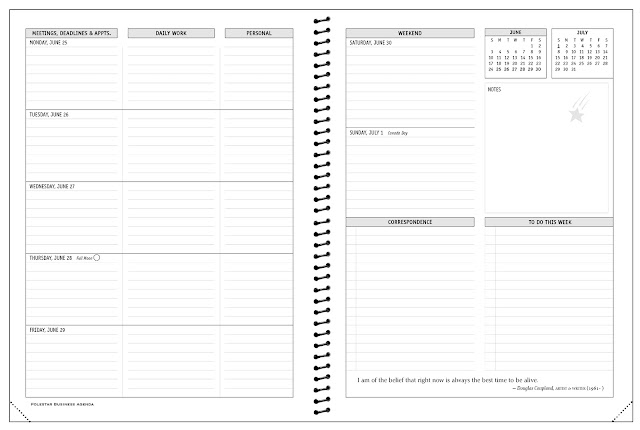
On the right page you'll see the weekend days have nice big spaces, and there's a large Notes area which is a great landing spot to jot those random things that pop up during the week. The bottom half of the page has two list areas with square checkboxes at the front of each line, which is where I like them to be so I can use them to indicate priority and then check them off when each task is done. I'm using the left list for work tasks, and the right one for personal/ home/ family tasks. Again I love having the separation of work/ personal, it helps me focus on what I'm doing at that time.
Canadian and USA holidays and phases of the moon are printed in the day spaces. Each week there is an inspirational quote.
You can't tell from my photos but the paper in the Business Agenda is a warm off-white that is easy on the eyes.
Get ready for me to gush some more: I love the monthly pages. They are embedded within the weeks, which I used to not care for but have recently converted to loving because I end up using the monthly pages more. Again my photo is not the best so please scroll down to the next image, taken (with permission) from the Polestar Calendars website.
I love the right page with Goals & Objectives, To Do, and Projects for each month. I'm finding it very useful to see these alongside the month for easy planning of the big-picture goals, plans and ideas. I drew a line down the middle of each monthly Goals/ To-Do/ Projects page, and am using the left side for work and the right side for personal.
Here are some more excellent features in this planner:
There are monthly overview pages to help you plan longer-range projects.
There are also monthly planning pages for the future year, so you have a place to plan into the next year.
There are also pockets inside the front and back covers of the planner. These pockets hold full size pages folded in half.
The
Business Agenda also has Contacts pages, USA and Canada reference pages, and several lined pages for notes. Perforated corners allow you to find your current page easily.
This is a very comprehensive planner that is flexible in its design so you can use it in any way that works best for you.
Next I'll show you the
Polestar Planner. This is an excellent, portable and affordable planner that also has a very flexible format so you can use it in any way you need.
The art on the cover is beautiful!
The
Polestar Planner measures 6 by 9 inches and is very slim and lightweight so you can take it with you everywhere in your bag.
The weekly layout has big open spaces to write your appointments, tasks, and personal items. Or of course you could re-label these and use them in any way you like. Again my photo is not the best so please scroll down for a clearer image.
Each week has a space for lists and notes, and an inspirational quote.
The monthly calendars are all located at the front of the planner, and are oriented this way on the page to give more writing space in the daily boxes:
Below you can see a better image. Each month there is a page for tasks, projects and notes.
Other excellent features include planning calendars for the current year (which I somehow failed to take a photo of), and for the future year:
And pockets inside the front and back covers of the planner.
There are also Contact pages, and several lined and blank pages for notes.
The paper in the Polestar Planner is bright, clear white. The tear-off corners let you mark your current page.
This is a fantastic planner at an excellent price!
I am absolutely in love with these planners and with this company. Check out their
website, you are sure to find a planner to fit your lifestyle!
You can find all the Polestar Calendar products at
PolestarCalendars.com!
Disclaimer: I bought these planners myself. This post does not contain any affiliate links. I am not affiliated with Polestar Calendars in any way, I'm just a very happy customer!


